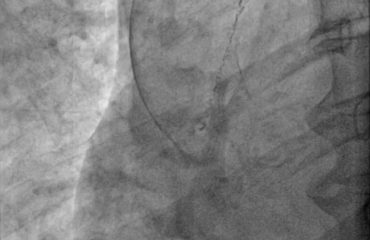
Descrição do caso: A 32-year-old man with no known medical conditions or cardiovascular risk factors presented with typical angina (CCS class III) for 4 weeks. Baseline ECG and transthoracic echocardiogram were unremarkable, but stress echocardiography showed ischemia in the left anterior descending (LAD) territory. Coronary angiography revealed severe proximal and mid LAD stenoses (Movie 1).
In view of these findings, percutaneous coronary intervention (PCI) was performed under optical coherence tomography (OCT) guidance to clarify the underlying lesion aetiology and optimise treatment.
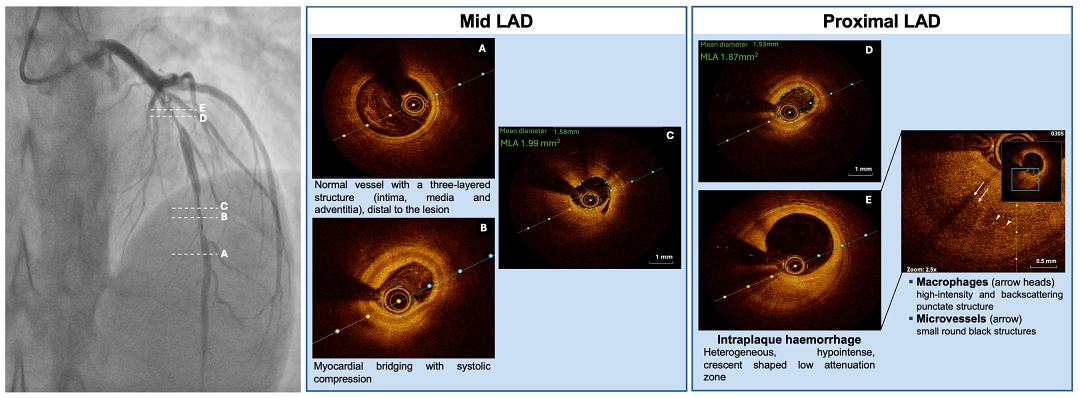
OCT identified two distinct mechanisms: myocardial bridging with systolic compression in the mid LAD [minimal luminal area (MLA) 1.87 mm²], and an intimal, heterogeneous, hypointense, crescent-shaped, low-attenuation lesion in the proximal LAD, suggestive of intraplaque haemorrhage (MLA 1.99 mm²), without evidence of plaque rupture (Figure). Within the half-moon shaped zone, high-intensity and backscattering punctate structures compatible with macrophages along with neovascularization were seen. All these findings (morphology, intimal location, macrophages, neovascularization) supported the diagnosis of intraplaque haemorrhage as the substrate of the lesion, helping to exclude intramural haematoma, which is typically located in the media, and lipid-rich plaque, which usually shows high attenuation and poorly defined borders.
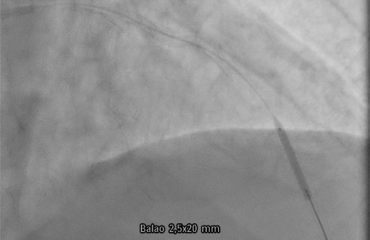
After performing adequate lesion preparation, sirolimus-eluting balloons were used (2.5 × 20 mm in the mid LAD and 3.5 × 20 mm in the proximal LAD). Final angiography (Movie 2) and OCT imaging (MLA 4.13 mm² in the mid LAD and 6.5 mm² in the proximal LAD) confirmed good result.
The patient became asymptomatic, and 3-month angiographic follow-up confirmed a sustained result.
This case highlights three main points:
- Intracoronary imaging is essential to understand coronary artery disease pathophysiology.
- Intraplaque haemorrhage without intimal rupture has distinctive imaging features that interventional cardiologists should recognize.
- Drug-coated balloons (DCB) are increasingly used for de novo lesions in large coronary vessels, especially in young patients, with good results and avoiding stent implantation.
Autores: Ana Rita Pereira1, Alfonso Jurado-Román2, Santiago Jiménez-Valero2, Raúl Moreno2
Centro de origem: 1 La Paz University Hospital, Madrid, Spain – 2 Hospital Garcia de Orta, Almada, Portugal